Leading China Laser-Welded Finned Tube & Industrial Radiator Manufacturer
 +86-519-83505830
 yangjy@lanchenfinnedtube.com
+86-519-83505830yangjy@lanchenfinnedtube.com

DATE:2026-07-31
The choice of finned tube material directly affects the efficiency, stability and lifecycle costs of industrial heat exchangers. For high‑temperature, high‑pressure environments, the 15CrMo/12Cr1MoV alloy steel H‑type finned tube has become a widely adopted solution. This article takes a comparative perspective on different finned tube materials and structures, focusing on how a reliable 15CrMo/12Cr1MoV alloy steel H‑type finned tube China supplier can help engineering projects balance performance, cost and long‑term safety.
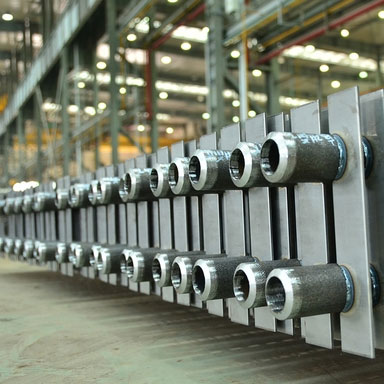
A 15CrMo/12Cr1MoV alloy steel H‑type finned tube is a welded composite heat transfer element designed for high‑temperature and high‑pressure service. It consists of an alloy steel base tube and H‑shaped fins made from heat‑resistant alloy steel plates, assembled to increase the external heat transfer area while maintaining structural strength.
The product is composed of:
Typical material combinations:
These materials offer enhanced creep strength, oxidation resistance and structural stability in high‑temperature service compared with standard carbon steel.
Common size range for H‑type finned tubes:
Within this range, engineers can optimally balance heat transfer area, flow resistance and mechanical strength based on site conditions and process parameters.
When selecting finned tubes, two questions arise: what fin structure to choose (H‑type vs. spiral or plate) and which material to adopt (carbon steel vs. alloy steel). For many high‑temperature flue gas and boiler systems, the 15CrMo/12Cr1MoV alloy steel H‑type finned tube offers a nuanced compromise between cost, service life and safety margin.
Compared with ordinary carbon steel finned tubes, 15CrMo and 12Cr1MoV alloy steels have improved creep resistance and higher allowable stress at elevated temperatures. In long‑term operation:
For users, this often translates into extended service life and fewer unplanned shutdowns in furnace, reheater, economizer and waste heat recovery applications.
Boiler flue gas, sintering waste heat and chemical exhaust streams often contain sulfur, dust and moisture. Under these conditions:
In combination with a suitable coating system or upstream gas pretreatment, a 15CrMo/12Cr1MoV alloy steel H‑type finned tube China supplier can help reduce tube failure rates and improve long‑term stability of boiler tail‑end and heat recovery equipment.
The H‑type fin is essentially a double‑plate fin assembly, forming a flat, robust heat transfer surface:
In many retrofit cases, users report that judicious switching from conventional finned tubes to alloy steel H‑type finned tubes can reduce tube replacement frequency by an observable margin, even when operating at similar temperature and dust levels.
Changzhou LanChen Environmental Equipment Co., Ltd. specializes in high‑efficiency heat exchange components. While it is widely recognized for its stainless steel laser‑welded finned tubes, the company also offers alloy steel H‑type finned tubes tailored for high‑temperature, high‑pressure working conditions.
Laser‑welded finned tubes from Changzhou LanChen feature:
This set of characteristics is particularly suited for compact, high‑efficiency heat exchangers, such as air preheaters, textile drying units and chemical process heaters. By contrast, the 15CrMo/12Cr1MoV alloy steel H‑type finned tube serves as a robust option for high‑dust, high‑temperature boiler tail‑end and waste heat recovery fields. Together, they provide engineers with a broader toolset to match specific flue gas and process conditions.
Changzhou LanChen has established a standardized production management and control system with:
Such capacity and mechanized welding lines are also relevant for consistent production of H‑type alloy finned tubes, where dimensional tolerance, fin spacing and weld quality directly affect heat exchanger assembly and on‑site installation.
Changzhou LanChen Environmental Equipment Co., Ltd. has obtained ISO9001 Quality Management System Certification (GB/T19001:2016 / ISO9001:2015) covering the production of finned tubes. The certification can be verified through the official platform of the Certification and Accreditation Administration of China, providing traceable documentation for project owners and EPC contractors.
For users choosing a 15CrMo/12Cr1MoV alloy steel H‑type finned tube China supplier, this type of third‑party certification offers a practical baseline for evaluating manufacturing discipline, documentation and consistent product quality.
Beyond technical specifications, project experience often determines whether a supplier can meet complex working conditions. Changzhou LanChen has delivered finned tubes and radiators to multiple sectors:
One notable example is the world’s first supercritical CO₂ sintering waste heat power generation demonstration project at Shougang Shuicheng Steel in Guizhou. The flue gas heat exchanger in this system adopts small‑diameter stainless steel spiral finned tubes manufactured by advanced laser welding. Traditional high‑frequency welded solutions previously faced problems such as low bonding rate, fin detachment and tube deformation, whereas the laser‑welded version achieved 100% welding bonding rate and zero post‑weld deformation, supporting long‑term safe operation.
This kind of engineering practice demonstrates the importance of both material selection and welding process, whether the design requires stainless laser‑welded spirals or alloy steel H‑type finned tubes for more severe dust and temperature loading.
The 15CrMo/12Cr1MoV alloy steel H‑type finned tube is typically used in:
In many cases, replacing traditional finned tubes with alloy steel H‑type finned tubes can yield measurable benefits. Depending on the baseline performance and working conditions, users may observe:
When engineers evaluate high‑temperature finned tube options, they often compare:
A simplified comparison perspective:
| Option | Main Strengths | Typical Use Case |
|---|---|---|
| Carbon steel H‑type finned tube | Lower initial cost; suitable for moderate temperature and less corrosive flue gas | Standard boiler tail‑end, low‑sulfur fuels, shorter design life |
| 15CrMo/12Cr1MoV alloy steel H‑type finned tube | Higher high‑temperature and creep strength; better oxidation resistance; improved durability | High‑temperature boilers, sinter waste heat, dust‑laden flue gas, longer design life |
| Stainless steel laser‑welded finned tube | High corrosion resistance, smooth welds, narrow fin spacing, very high heat transfer density | Chemical, textile, high‑efficiency compact heat exchangers, corrosive media |
Depending on the plant’s fuel type, flue gas composition, temperature profile and maintenance strategy, different combinations may be selected. In many large projects, Changzhou LanChen Environmental Equipment Co., Ltd. provides tailored configurations that combine alloy steel H‑type finned tubes in high‑dust zones with stainless laser‑welded tubes in cleaner, high‑efficiency sections, balancing cost and performance.
Choice mainly depends on design temperature, pressure, flue gas composition and design life. For flue gas temperatures approaching the upper limits of carbon steel, or where long, stable operation is required, 15CrMo/12Cr1MoV alloy steel H‑type finned tubes usually provide a safer margin. For lower‑temperature, less corrosive conditions, carbon steel may suffice.
Standard base tube outer diameters include φ38, φ42, φ51, φ57 and φ76 mm, with wall thickness between 3.0 and 5.0 mm. Fixed lengths of 3–9 m are common. Within this envelope, most 15CrMo/12Cr1MoV alloy steel H‑type finned tube China suppliers can offer customized combinations of fin height, thickness and spacing to suit project‑specific heat transfer calculations.
Yes. Many systems integrate alloy steel H‑type finned tubes in zones with severe dust and erosion, while adopting stainless steel laser‑welded finned tubes in cleaner or more compact sections. This allows optimized investment distribution, using higher‑cost materials and processes where they generate the most value.
Fin height (12–22 mm), thickness (1.5–2.5 mm) and spacing (10–20 mm) directly influence external heat transfer area and gas flow resistance. Closer spacing and taller fins increase area but may raise pressure drop and ash deposition risk. Proper design balances these factors, often using computational or empirical methods based on the specific boiler or process configuration.
A trustworthy 15CrMo/12Cr1MoV alloy steel H‑type finned tube China supplier should provide material certificates, dimensional inspection records, weld procedure documentation and, ideally, quality management certification such as ISO9001. For critical projects, additional non‑destructive testing reports and batch process records are often requested to support acceptance and future traceability.

Service hotline+86-519-83505830
Professional China Manufacturer & Supplier of Finned Tubes: Laser-Welded, High-Frequency Welded, Steel-Aluminum Composite, H-Type, Longitudinal, Inlaid Finned Tubes, and Serpentuator Tubes.
Copyright @ 2026-2036 Changzhou LanChen Environmental Protection Equipment Co., Ltd.