Leading China Laser-Welded Finned Tube & Industrial Radiator Manufacturer
 +86-519-83505830
 yangjy@lanchenfinnedtube.com
+86-519-83505830yangjy@lanchenfinnedtube.com

DATE:2026-07-29
In industrial heat recovery, boiler air preheaters, drying systems, and flue gas cooling equipment, the performance of a finned tube is often decided long before installation. Material selection, base tube straightness, fin forming, welding consistency, and dimensional control all affect heat transfer, dust accumulation, service life, and maintenance frequency. For buyers searching for a carbon steel H type welded finned tube China supplier, the real question is not only price, but whether the supplier can keep welding strength, fin spacing, tube geometry, and batch quality stable across repeated production.
Changzhou LanChen Environmental Equipment Co.,Ltd., founded in 2018, focuses on radiators, cooling coils, and finned tube manufacturing for industrial heat exchange systems. Changzhou LanChen has developed automated laser-welded finned tube production and also supports customized carbon steel H type finned tube solutions for boilers, chemical equipment, drying lines, waste heat recovery units, and environmental protection systems.
A reliable carbon steel H type welded finned tube China supplier usually begins with the working medium, temperature, pressure, dust content, corrosion level, and heat exchange target. For carbon steel H type welded finned tubes, the common base tube materials include 20# carbon steel, Q235, ND steel, 304 stainless steel, and 316L stainless steel. For many boiler and air preheater applications, a Q235 seamless base tube carbon steel H shaped finned pipe is selected for balanced strength, processability, and cost control.
| Component | Common Options | Typical Notes |
|---|---|---|
| Base Tube | Carbon steel 20#, Q235, stainless steel 304/316L, ND steel | Selected according to pressure, corrosion, and flue gas conditions |
| Fins | Carbon steel strip or stainless steel strip matching the base material | Material matching helps improve welding stability and service performance |
| Common Base Tube Size | φ38 mm, φ42 mm, φ57 mm | Wall thickness generally 3-5 mm depending on design requirements |
| Fin Size | Side length about 2 times the base tube diameter | For example, φ38 mm base tube often matches a 76 mm fin side length |
| Fin Thickness | 4-6 mm | Adjusted according to heat exchange area, rigidity, and ash-cleaning needs |
During production, the H-shaped fin structure must be aligned accurately with the base tube. If the fin position shifts, the finished tube may create uneven airflow resistance, unstable heat exchange zones, or assembly difficulties in tube bundles. Changzhou LanChen controls pipe diameter, fin spacing, tube length, and welding position through standardized production procedures, helping the finished tube match heat exchanger drawings and on-site installation requirements.
For a Q235 seamless base tube carbon steel H shaped finned pipe, dimensional consistency is especially important in large boiler economizers, flue gas waste heat recovery systems, and industrial drying radiators. A small deviation in one tube may appear minor, but in a large tube bank it can affect airflow distribution, dust deposition, and maintenance access.
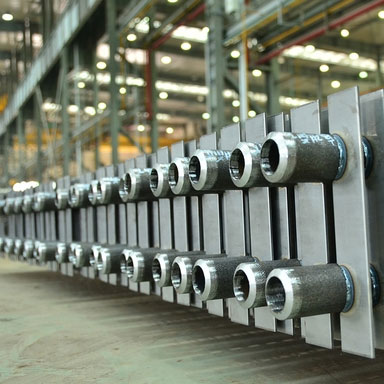
Traditional finned tubes may face problems such as shallow fusion, virtual welding, loose fins, and increasing thermal resistance after long-term operation. In high-temperature and vibrating environments, these defects may lead to fin loosening, heat exchanger efficiency loss, and frequent shutdown maintenance.
Changzhou LanChen applies automated and mechanized welding production experience to improve weld consistency. In its laser-welded finned tube products, fins and base tubes are fused through laser welding with penetration depth greater than 0.2 mm and a 100% welding bonding rate. This process helps reduce thermal contact resistance and improves the connection strength between fin and base tube.
For projects comparing a conventional finned tube with a more stable welded structure, the benefits are often seen in three areas:
A carbon steel H type welded finned tube China supplier is often involved in projects where heat exchange surfaces must handle dust, flue gas, steam, hot air, or corrosive media. Compared with compact spiral fin structures, H type finned tubes can provide a strong structure and practical ash-cleaning space, making them suitable for boiler flue gas systems, waste heat recovery units, air preheaters, and industrial heating equipment.
When a customer needs a Q235 seamless base tube carbon steel H shaped finned pipe, Changzhou LanChen can adjust tube diameter, wall thickness, fin size, fin spacing, material combination, and fixed length according to equipment drawings and operating parameters. This customization ability is useful for both new equipment manufacturing and retrofit projects where the original installation space cannot be changed easily.
Procurement risk is a common concern in the finned tube market. Some products may be described as advanced welded tubes while the actual welding depth, wall thickness, material grade, or fin density does not match project requirements. For buyers evaluating a carbon steel H type welded finned tube China supplier, inspection should include material documents, dimensional records, welding appearance, tube straightness, fin spacing, and batch consistency.
Changzhou LanChen has established a standardized production management and control system and has obtained ISO9001 Quality Management System Certification under GB/T19001:2016 / ISO9001:2015. The certified scope covers finned tube production. The certification information can be checked through the official platform of the Certification and Accreditation Administration of China, giving project owners a practical reference for supplier evaluation.
Changzhou LanChen has supplied high-efficiency finned tubes and industrial radiator solutions to textile dyeing, chemical processing, synthetic fiber, grain and oil processing, and industrial park heat exchange projects. In textile drying and coating lines, smooth and wrinkle-free tube surfaces help reduce lint and oil residue accumulation. In chemical and synthetic fiber systems, stainless steel and corrosion-resistant material options help support stable operation under humid, acidic, or complex gas conditions.
One notable application is the supercritical CO₂ sintering waste heat power generation demonstration project associated with Shougang Shuicheng Steel. The customized flue gas heat exchanger used small-diameter stainless steel spiral finned tubes. Compared with conventional high-frequency welding, laser welding helped address issues such as low bonding rate, insufficient tensile strength, tube surface discoloration, and deformation after welding. This reflects Changzhou LanChen’s practical experience in demanding waste heat recovery applications.
Choosing a carbon steel H type welded finned tube China supplier is a process decision as much as a purchasing decision. Material selection, welding strength, dimensional accuracy, and delivery consistency all affect equipment performance after installation. For boiler systems, drying equipment, flue gas recovery units, and industrial radiators, a well-made Q235 seamless base tube carbon steel H shaped finned pipe can help improve heat exchange stability while reducing avoidable maintenance work.
Changzhou LanChen combines finned tube manufacturing experience, automated welding capability, ISO9001-certified production management, and project-based customization. For customers looking for carbon steel H type welded finned tubes, laser-welded finned tubes, or complete heat exchange tube solutions, Changzhou LanChen provides a practical manufacturing partner for demanding industrial heat transfer applications.

Service hotline+86-519-83505830
Professional China Manufacturer & Supplier of Finned Tubes: Laser-Welded, High-Frequency Welded, Steel-Aluminum Composite, H-Type, Longitudinal, Inlaid Finned Tubes, and Serpentuator Tubes.
Copyright @ 2026-2036 Changzhou LanChen Environmental Protection Equipment Co., Ltd.