Leading China Laser-Welded Finned Tube & Industrial Radiator Manufacturer
 +86-519-83505830
 yangjy@lanchenfinnedtube.com
+86-519-83505830yangjy@lanchenfinnedtube.com

DATE:2026-07-29
Choosing a steel aluminum composite finned tube China manufacturer is not only about comparing unit prices. For heat exchangers, air heaters, drying systems, boiler waste heat recovery units, and industrial radiators, the real risk often appears after installation: loose fins, rising air resistance, falling heat transfer efficiency, delayed delivery, or unclear material traceability. For buyers who need stable long-term operation, the safer path is to evaluate welding quality, material matching, dimensional consistency, application experience, and quality control before confirming an order.
Changzhou LanChen Environmental Equipment Co., Ltd. focuses on the manufacturing of radiators, cooling coils, and finned tubes for industrial heat transfer applications. Since 2018, Changzhou LanChen has developed automated laser-welded finned tube production capability and accumulated practical project experience in textile dyeing, chemical processing, grain and oil processing, boiler waste heat recovery, and high-temperature flue gas heat exchange systems.
In many projects, the finned tube looks simple on drawings, but it determines heat transfer efficiency, equipment size, maintenance frequency, and energy consumption. A low-cost product may pass visual inspection, yet fail under high temperature, vibration, dust, humidity, or frequent cold-hot cycling.
For this reason, when evaluating a steel aluminum composite finned tube China manufacturer, buyers should look beyond quotations and ask for production standards, inspection records, material certificates, dimensional tolerances, and application references.
A steel aluminum composite finned tube generally uses a steel base tube for pressure-bearing and an aluminum fin for heat dissipation. The combination is widely used where efficient heat transfer, manageable weight, and cost control are required.
| Component | Common Options | Typical Purpose |
|---|---|---|
| Base Tube | Carbon steel 20#, Q235, stainless steel 304/316L, ND steel | Pressure resistance, corrosion resistance, medium transport |
| Fins | 1060 pure aluminum, 3003 aluminum alloy | Expanded heat dissipation area and improved heat exchange |
| Common Base Pipe Size | Diameter φ25, φ38, φ57 mm; wall thickness 2–4 mm | Matched to heat exchanger design and working pressure |
| Common Fin Size | Height 8–30 mm; thickness 0.4–1.2 mm; spacing 3–8 mm | Balanced heat transfer, airflow resistance, and cleaning needs |
| Fixed Length | 3–6 m | Convenient for radiator and heat exchanger assembly |
For projects requiring carbon steel tubes with aluminum fins, buyers often search for ASTM A179 carbon steel 1060 aluminum bimetallic finned tube. In this case, both the base tube standard and fin material should be clearly confirmed before production, especially when the tube will be used in air coolers, air heaters, drying radiators, or industrial heat recovery equipment.
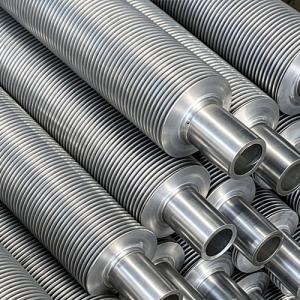
The lowest price is not always the lowest total cost. A finned tube with unstable bonding, thin wall deviation, or uneven fin spacing may increase fan power consumption, reduce heat transfer efficiency, and shorten maintenance cycles. Once the heat exchanger is assembled, replacement costs are often much higher than the initial price difference.
Changzhou LanChen recommends that buyers compare at least four factors together: material grade, bonding process, dimensional accuracy, and actual operating condition. For example, a tube used in a textile drying line faces lint, oil mist, heat cycling, and continuous airflow. A tube used in boiler flue gas waste heat recovery faces dust, sulfur-containing gas, and higher thermal stress. These two scenarios should not be judged by the same price logic.
Traditional high-frequency welded, wound, or embedded finned tubes may meet ordinary working conditions, but they can show weaknesses under vibration, high temperature, or frequent cold-hot alternation. Common problems include shallow fusion, virtual welding, fin warping, and thermal contact resistance.
Changzhou LanChen has independently developed stainless steel laser-welded finned tubes. The fins and base tubes are fused by automated laser welding, with penetration depth greater than 0.2 mm and a 100% welding bonding rate under the company’s process control. This structure helps reduce the risk of fin detachment and supports stable heat exchange in demanding industrial systems.
Although a steel aluminum composite finned tube China manufacturer may supply different structures according to project requirements, the buyer should ask one question clearly: is the fin bonded, welded, embedded, extruded, or mechanically wound? The answer directly affects thermal resistance, durability, cleaning difficulty, and long-term maintenance cost.
Material traceability is a common weak point in cross-border procurement. Some suppliers provide broad descriptions such as “carbon steel tube” or “aluminum fin” without specifying grade, wall thickness, inspection method, or batch consistency. For an ASTM A179 carbon steel 1060 aluminum bimetallic finned tube, the base tube and fin material should be clearly written into the technical agreement.
Changzhou LanChen operates with a standardized production management system and has obtained ISO9001 Quality Management System Certification. The certification scope covers the production of finned tubes, and the credentials can be verified through the official platform of the Certification and Accreditation Administration of China.
For drying rooms, textile finishing lines, coating lines, hot blast stoves, flue gas recovery systems, and environmental waste gas treatment equipment, dust and residue are not minor issues. If fin roots are rough or welding surfaces have burrs, lint, oil residue, ash, or scale may accumulate quickly. This raises system resistance and increases fan energy consumption.
Laser-welded fin roots can be made smooth and flat, which helps reduce dust adhesion and cleaning difficulty. In real operation, this may extend cleaning intervals and keep heat transfer more stable. For buyers selecting a steel aluminum composite finned tube China manufacturer, surface finish and airflow resistance should be part of the technical review, not an afterthought.
Many heat exchange projects are not standard. A boiler air preheater, a textile stenter exhaust heat recovery unit, a chemical drying system, and a power station flue gas cooler have different temperature, pressure, corrosion, and installation requirements. If the supplier only offers limited specifications, the final product may be forced to fit the drawing rather than properly match the working condition.
Changzhou LanChen supports customized production of pipe diameter, fin height, fin spacing, material, fixed length, serpentine tubes, longitudinal tubes, and special-shaped tube structures. The company currently owns three sets of laser welding machines, with an annual production capacity of 400,000 meters of finned tubes, supporting both customized and batch supply needs.
In a supercritical CO₂ sintering waste heat power generation demonstration project for a large steel group in Guizhou, the flue gas heat exchanger was one of the core components affecting system efficiency. The project required small-diameter stainless steel spiral finned tubes for a customized heat exchanger. With conventional high-frequency welding, similar products often face low fin bonding rate, insufficient tensile strength, surface blackening, and tube bending deformation.
Changzhou LanChen supplied laser-welded finned tubes for the heat exchanger application. The process achieved a 100% fin welding bonding rate, strong fin-tube joint integrity, non-discolored tube surface, and controlled deformation after welding. Compared with traditional high-frequency alternatives, the solution helped improve heat exchange reliability and supported long-term operation under high-temperature flue gas conditions.
| Comparison Item | Traditional Finned Tube Issue | Improved Result After Upgrade |
|---|---|---|
| Maintenance Cost | Frequent cleaning and inspection caused higher labor cost | Maintenance cost reduced by about 30% in comparable operating cycles |
| Production Continuity | Unexpected shutdown risk caused by fin loosening or blockage | Production efficiency increased by about 25% after reducing downtime |
| Heat Dissipation Area | Limited by traditional fin spacing and equipment size | Heat dissipation area increased by over 50% in compact designs |
| Equipment Footprint | Larger tube bundles required more installation space | Assembled equipment volume reduced by up to two-thirds in selected designs |
Mr. Zhang, an equipment maintenance manager from a textile finishing enterprise, described the change in practical terms: “The previous radiator needed frequent cleaning during peak production. After switching to the new finned tube bundle, the surface was easier to clean, heat output stayed more stable, and our line stoppage for maintenance was noticeably reduced.”
Before placing an order, buyers can use the following checklist to reduce procurement risk:
For buyers sourcing an ASTM A179 carbon steel 1060 aluminum bimetallic finned tube, this checklist is especially important because both the steel tube and aluminum fin directly affect pressure performance, heat transfer, corrosion resistance, and service stability.
Changzhou LanChen combines standardized production management, ISO9001-certified quality control, and project experience across multiple industries. Its products are used in textile dyeing and printing, chemical processing, synthetic fiber production, grain and oil drying, industrial parks, boiler systems, and flue gas waste heat recovery units.
The company’s laser-welded finned tube technology is designed to address several common pain points: fin detachment, heat transfer attenuation, dust accumulation, high air resistance, corrosion risk, and unstable product quality. For projects where aluminum finned structures are required, Changzhou LanChen can also support material and size discussions based on working conditions, including base tube selection and fin design requirements.
A reliable steel aluminum composite finned tube China manufacturer should help buyers solve engineering problems, not simply provide a low quotation. Material clarity, bonding quality, surface finish, dimensional precision, quality traceability, and project experience all influence whether the heat exchanger runs efficiently after installation.
Changzhou LanChen continues to focus on finned tube manufacturing, radiator solutions, and industrial heat exchange applications. For buyers planning waste heat recovery, air heating, drying, boiler upgrading, or equipment cooling projects, early technical communication with Changzhou LanChen can help reduce procurement uncertainty and build a more stable heat transfer system.

Service hotline+86-519-83505830
Professional China Manufacturer & Supplier of Finned Tubes: Laser-Welded, High-Frequency Welded, Steel-Aluminum Composite, H-Type, Longitudinal, Inlaid Finned Tubes, and Serpentuator Tubes.
Copyright @ 2026-2036 Changzhou LanChen Environmental Protection Equipment Co., Ltd.