Leading China Laser-Welded Finned Tube & Industrial Radiator Manufacturer
 +86-519-83505830
 yangjy@lanchenfinnedtube.com
+86-519-83505830yangjy@lanchenfinnedtube.com

DATE:2026-07-29
For engineers comparing finned tube options, the search often begins with a practical phrase: High frequency welded finned tube manufacturer in China. It is a familiar category in industrial heat exchange, especially for boilers, dryers, air heaters, flue gas recovery units, and radiators. Yet in many high-temperature or dusty working conditions, traditional high-frequency welded finned tubes may face limitations in bonding strength, thermal resistance, deformation control, and maintenance frequency.
Changzhou LanChen Environmental Equipment Co.,Ltd. focuses on radiators, cooling coils, and laser-welded finned tubes for industrial heat transfer systems. Founded in 2018, Changzhou LanChen has developed stainless steel laser-welded finned tubes through automated and mechanized welding processes. The product is positioned as an upgraded alternative for projects that originally considered conventional high-frequency welded finned tubes but require more stable performance under cold-hot cycling, vibration, dust, humidity, or corrosive gas conditions.
This article takes a practical view of product selection, working-condition risks, material configuration, and real application feedback. It is written for buyers, equipment manufacturers, project engineers, and maintenance teams who are evaluating a High frequency welded finned tube manufacturer in China, while also considering whether laser-welded finned tubes can reduce long-term maintenance pressure and improve heat exchange stability.
In many factories, the first issue is not whether the heat exchanger works on day one, but whether it can maintain performance after months or years of operation. Traditional high-frequency welded, wound, or embedded finned tubes may suffer from shallow fusion, virtual welding, or insufficient fin-to-base-tube contact. Under high-temperature flue gas, vibration, and frequent cold-hot alternation, fins can loosen, warp, or detach, which reduces heat transfer efficiency and increases shutdown maintenance.
Another common problem is gradual efficiency decay. Small gaps at the weld interface increase thermal resistance. Dust, oil mist, oxide scale, and chemical residue may accumulate around rough fin roots. Over time, the same heat exchanger may require higher steam consumption, more fan power, or longer heating time to reach the original process temperature. For energy-saving renovation projects, this performance decline becomes a hidden operating cost.
Procurement risk is also a real concern. Some projects searching for a High frequency welded finned tube manufacturer in China encounter uneven product quality, false labeling, reduced wall thickness, unstable fin density, or non-standard dimensions. These issues may not be obvious during quotation comparison, but they can affect equipment acceptance, installation accuracy, warranty disputes, and long-term reliability.
A laser-welded finned tube is produced by welding continuous fins onto the outer wall of seamless or welded base tubes using laser fusion technology. In Changzhou LanChen’s process, fins and base tubes are fused through automated welding, with a penetration depth greater than 0.2 mm. This structure forms a dense metallurgical connection and helps achieve a 100% welding bonding rate between fin and tube.
Compared with conventional high-frequency welded finned tubes, the laser-welded structure reduces thermal contact resistance and improves heat conduction from the internal medium to the outside air or flue gas flow. The fin spacing can be controlled at ≤1.8 mm in suitable designs, expanding heat dissipation area by over 50% compared with traditional structures. In compact equipment layouts, this can reduce the assembled heat exchanger volume by up to two-thirds under comparable heat exchange requirements.
Changzhou LanChen also controls fin thickness to ≤0.5 mm for certain applications, reducing material consumption by more than 50% versus conventional counterparts. Smooth, wrinkle-free welds make the tubes easier to clean, especially in textile exhaust recovery, coating lines, drying systems, boiler flue gas recovery, and waste gas treatment units where dust, lint, oil residue, or chemical particles may adhere to heat exchange surfaces.
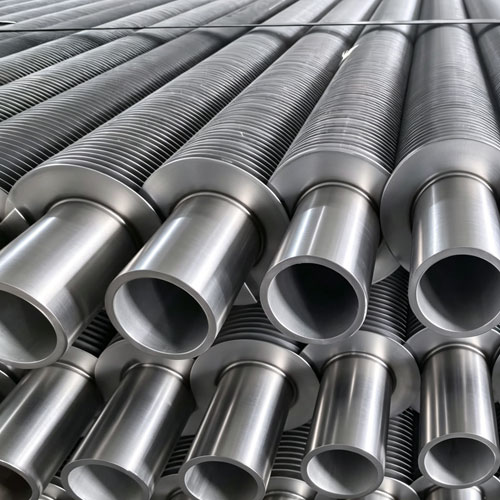
Material selection determines whether a finned tube can survive the actual medium, temperature, pressure, and corrosion environment. Changzhou LanChen supports common base tube materials such as carbon steel 20#, Q235, stainless steel 304/316L, ND steel, alloy steel, and copper pipe. Fin materials include steel strip, aluminum strip, and stainless steel strip, allowing different combinations for heating, cooling, drying, waste heat recovery, and anti-corrosion scenarios.
The secondary specification often requested by buyers is 20# Q235 Carbon Steel / SS304 SS316L ND Steel Base Tube with Steel & Aluminum Strip Fins. This reflects a common procurement need: one supplier must match carbon steel cost efficiency, stainless steel corrosion resistance, ND steel sulfuric acid dew-point corrosion resistance, and aluminum strip heat dissipation characteristics according to the project environment.
For size range, base tube diameter generally covers φ25–φ114 mm, with common sizes such as φ25, φ38, and φ57. Wall thickness is typically 2–5 mm. Fin height can range from 8–60 mm, with 10–20 mm commonly used; fin thickness ranges from 0.3–1.5 mm, while industrial designs often use 0.8–1 mm. Fin spacing can be designed from 2–12 mm, and fixed tube length is usually 3–9 m.
| Component | Common Options | Typical Use Consideration |
|---|---|---|
| Base Tube | 20#, Q235 carbon steel | General heating, radiators, standard heat exchange conditions |
| Base Tube | SS304 / SS316L stainless steel | Humid, corrosive, chemical, food-related, or clean process environments |
| Base Tube | ND steel | Flue gas waste heat recovery with dew-point corrosion risk |
| Fins | Steel strip, aluminum strip, stainless steel strip | Selected according to heat transfer demand, corrosion level, and weight requirement |
For buyers comparing a High frequency welded finned tube manufacturer in China, these configuration details are important because similar-looking products may behave differently in service. Wall thickness, fin spacing, fin height, tube straightness, weld penetration, and material grade all influence installation accuracy, pressure resistance, heat transfer performance, and maintenance cycle.
Industrial users are under pressure to reduce energy consumption, control emissions, and improve heat recovery efficiency. In boilers, power stations, chemical plants, textile dyeing factories, and environmental treatment systems, heat exchangers are no longer just auxiliary equipment. They directly affect fuel consumption, steam balance, exhaust temperature, and the economic return of energy-saving renovation projects.
From a supply chain perspective, imported high-end heat exchange tubes may involve long delivery cycles, higher costs, and inconvenient after-sales support. At the same time, low-cost domestic products may not meet demanding working conditions such as high sulfur flue gas, frequent thermal cycling, corrosive chemical vapor, or high-pressure fluid delivery. This creates a practical gap between price, delivery, and reliability.
Changzhou LanChen addresses this gap through standardized production, automated laser welding, and flexible customization. The company currently owns three sets of laser welding machines, with an annual production capacity of 400,000 meters of finned tubes. For customers who originally searched for a High frequency welded finned tube manufacturer in China, this production capacity provides an alternative route for projects requiring stable batch quality and customized specifications.
In the world’s first supercritical CO₂ sintering waste heat power generation demonstration project at Shougang Shuicheng Steel, the flue gas heat exchanger became one of the core components affecting system efficiency. The project required small-diameter stainless steel spiral finned tubes for customized heat exchange equipment. Conventional high-frequency welding faced risks such as low bonding rate, insufficient tensile strength, blackened tube surface, and bending deformation.
Changzhou LanChen’s laser welding process helped solve these issues through a 100% fin welding bonding rate, higher tensile strength at the fin-tube interface, non-discolored tube surface, and reduced deformation after welding. In a system where supercritical CO₂ absorbs waste heat from sintering flue gas and drives power generation, stable heat exchanger performance supports safe long-term operation and improves the utilization of industrial waste heat.
In textile dyeing and coating applications, several plants used stainless steel laser-welded finned tubes for stenter exhaust gas heat recovery, hot-air drying, and fabric curing tunnels. Compared with previous high-frequency welded structures, customers reported smoother surfaces, less lint and oil residue accumulation, and longer cleaning intervals. In one coating line upgrade, the heat exchange area increased by more than 50% within the original cabinet size, while the assembled equipment footprint was reduced by about two-thirds.
A maintenance manager from a textile finishing company noted that after replacing conventional finned tubes, cleaning work changed from frequent manual scraping to scheduled light cleaning. The plant estimated a 30% reduction in maintenance-related cost over one heating season and a 25% improvement in line heating response during high-load production. The result was not only lower maintenance pressure, but also more stable process temperature during continuous operation.
In chemical and synthetic fiber facilities, laser-welded stainless steel finned tubes were used for process coolers, vapor condensation, solvent recovery, and drying heat exchangers. A production manager from a chemical processing company said the main value was not a single efficiency figure, but fewer unplanned shutdowns caused by leakage, corrosion, or fin separation. In their internal comparison, fan power and cleaning labor decreased after airflow resistance became more stable, helping reduce long-term operating costs.
Changzhou LanChen Environmental Equipment Co.,Ltd. has established a standardized production management and control system and obtained ISO9001 Quality Management System Certification under GB/T19001:2016 / ISO9001:2015. The certification scope covers the production of finned tubes, and the certification information can be verified through the official platform of the Certification and Accreditation Administration of China.
For engineering procurement, certification is only one part of evaluation. Buyers should also confirm material certificates, wall thickness, fin spacing tolerance, welding bonding rate, penetration depth, straightness, surface condition, and batch inspection records. These details are especially important when comparing a High frequency welded finned tube manufacturer in China with a supplier offering laser-welded alternatives.
Changzhou LanChen provides transparent parameters and supports process reports and quality test data for batch production. This helps reduce uncertainty during project acceptance, especially for heat exchangers used in boilers, power stations, chemical systems, environmental desulfurization and denitrification equipment, textile dryers, grain drying systems, and industrial radiators.
Laser-welded finned tubes are suitable for industrial boiler flue gas waste heat recovery, boiler air preheaters, large heating radiators, hot blast stoves, chemical equipment heating and cooling, drying system heat exchange units, power station flue gas cooling, and environmental waste gas treatment equipment. They are also used in breeding greenhouse heating, grain and material drying, central air-conditioning heat exchange units, and industrial cold and hot water heat exchangers.
The technology is particularly useful when the application involves repeated cold-hot cycling, high dust concentration, limited installation space, corrosive gas, or strict cleaning requirements. In these cases, smooth welds, firm fin bonding, and compact fin spacing are not just product features; they directly affect maintenance workload, heat exchange stability, and service life.
For companies beginning their search with High frequency welded finned tube manufacturer in China, the practical question is whether the working condition truly allows a standard conventional solution, or whether the project needs a more stable structure. If the system involves high temperature, vibration, dusty flue gas, corrosive media, or long continuous production cycles, laser-welded finned tubes may provide a more suitable balance of performance, maintenance, and lifecycle cost.
Changzhou LanChen combines automated laser welding, customized material selection, and standardized quality control to manufacture finned tubes for demanding industrial heat exchange conditions. Its laser-welded finned tubes offer firm fin bonding, low thermal resistance, smooth weld seams, compact structure, and adaptability to carbon steel, stainless steel, ND steel, alloy steel, and other material systems.
When evaluating a High frequency welded finned tube manufacturer in China, buyers may benefit from looking beyond the initial unit price and comparing weld bonding, heat transfer stability, dust resistance, corrosion adaptability, delivery capability, and maintenance cost. In many real projects, the better choice is the one that keeps heat exchange performance stable after long-term operation.
For boilers, dryers, textile heat recovery systems, chemical process equipment, and waste heat recovery projects, Changzhou LanChen provides a practical finned tube solution supported by production capacity, ISO9001 quality management, and field application experience. The key value lies in helping equipment operate with steadier heat transfer, fewer cleaning interruptions, and better adaptability to complex industrial conditions.

Service hotline+86-519-83505830
Professional China Manufacturer & Supplier of Finned Tubes: Laser-Welded, High-Frequency Welded, Steel-Aluminum Composite, H-Type, Longitudinal, Inlaid Finned Tubes, and Serpentuator Tubes.
Copyright @ 2026-2036 Changzhou LanChen Environmental Protection Equipment Co., Ltd.